
BMAC Therapy for Joint Pain: A Physician's Guide to Bone Marrow Aspirate Concentrate
If you've been living with joint pain and wondering whether there's a non-surgical option beyond cortisone shots and physical therapy, you may have come across the term BMAC — Bone Marrow Aspirate Concentrate. It's a type of orthobiologic therapy, meaning it uses your body's own biology to support the healing process.
This article explains what BMAC therapy is, how the procedure works, who may be an appropriate candidate, and what to realistically expect. As with all orthobiologic therapies, this is not a cure — and it isn't right for everyone. The goal here is to give you accurate, physician-level information so you can have an informed conversation with your provider. At Vitality Wellness Center in Davenport, Iowa, we offer BMAC as part of a comprehensive non-surgical joint care program serving active adults throughout the Quad Cities and surrounding communities.
What Is BMAC Therapy?
BMAC stands for Bone Marrow Aspirate Concentrate. It is an autologous orthobiologic therapy — meaning it is derived entirely from the patient's own body, not from donor tissue or synthetic sources.
Bone marrow contains a concentration of regenerative cells, growth factors, and signaling proteins that play a role in the body's natural tissue repair processes. In BMAC therapy, a small amount of bone marrow is harvested from the patient, processed to concentrate these biologically active components, and then precisely injected into the affected joint.
Because everything used in the procedure comes from the patient's own biology, there is no risk of rejection or immune reaction to donor material. This is a key distinction from some "stem cell" products marketed by other clinics, which may use amniotic or umbilical cord-derived tissue from outside the patient's body — a practice that has faced significant scrutiny from the FDA.
At Vitality Wellness Center, every orthobiologic therapy we offer — including BMAC — is autologous. It comes from you, and only you.
How Does BMAC Work?
Joint degeneration — whether from osteoarthritis, injury, or age-related wear — involves the breakdown of cartilage, inflammation, and impaired tissue repair. Conventional treatments often focus on managing symptoms. Orthobiologic therapies like BMAC are designed to work differently: by delivering a concentrated source of the body's own repair-signaling biology directly to the affected area.
When bone marrow aspirate is processed and concentrated, the resulting material contains a rich mix of growth factors, cytokines, and other biologically active components. These elements are involved in modulating inflammation and signaling the body's own repair mechanisms. The clinical evidence suggests that, in appropriate candidates, this may support:
• Reduced joint pain and inflammation
• Improved joint function and mobility
• Potentially slowing the progression of joint degeneration in certain cases
It is important to be honest about what BMAC: The response to treatment varies based on a number of individual factors.
BMAC vs. PRP: What's the Difference?
Patients often ask how BMAC compares to PRP (Platelet-Rich Plasma), another commonly offered orthobiologic therapy. Both are autologous — derived from your own body — but they differ in source material, biological content, and typical application.
| PRP | BMAC | |
|---|---|---|
| Source | Blood draw (arm) | Bone marrow aspiration (pelvis) |
| Primary biology | Concentrated platelets and growth factors | Regenerative cells, growth factors, cytokines |
| Procedure complexity | Lower | Higher — requires harvest procedure |
| Best suited for | Mild to moderate arthritis, tendon and ligament injuries | Moderate to advanced osteoarthritis, more significant degeneration |
| Typical visit time | ~45–60 minutes | ~60–90 minutes |
Neither therapy is universally superior. The appropriate choice depends on the specific joint, the degree of degeneration, the patient's overall health, and clinical judgment. Some patients are candidates for both — used together or in sequence.
Who May Be a Candidate for BMAC Therapy?
BMAC is generally considered for patients with moderate to advanced joint degeneration where more significant biological support may be warranted. Common conditions that may prompt a BMAC evaluation include:
• Moderate to advanced knee osteoarthritis
• Hip osteoarthritis with significant cartilage loss
• Shoulder joint degeneration
• Cases where PRP alone may be insufficient given the degree of degeneration
• Patients seeking a non-surgical option prior to considering joint replacement
BMAC is not appropriate for everyone. Factors that affect candidacy include overall health, bone marrow health, platelet function, certain medications (including blood thinners and long-term corticosteroid use), the severity of joint destruction, and patient goals. End-stage joint disease with bone-on-bone collapse may be better served by surgical evaluation.
The only way to determine whether you are an appropriate candidate is through a thorough evaluation with a physician who specializes in non-surgical joint care — including a review of imaging and a physical examination.
“Non-surgical care isn’t the right answer for everyone. Some patients I evaluate are better served by a surgical consultation — and when that’s the case, I’ll say so. My goal is to match you to the right option for your specific situation, not to offer the same treatment to every patient.”
What to Expect from the BMAC Procedure
The Consultation
The process begins with a consultation, during which Dr. Brooks reviews your imaging, evaluates the joint, and discusses your health history, goals, and treatment options. He may schedule you for a diagnostic ultrasound at Vitality, as well. If BMAC is appropriate, the procedure is scheduled as a separate visit. Consultations and diagnostic ultrasounds at Vitality are typically billed to insurance. The BMAC procedure itself is a cash-pay investment.
Preparing for the Procedure
Preparation matters significantly for orthobiologic procedures. Patients are asked to stop NSAIDs (ibuprofen, naproxen, aspirin above low-dose cardiac levels, meloxicam, and similar medications) before the procedure. These medications interfere with the inflammatory cascade that the therapy relies on. Acetaminophen (Tylenol) is an acceptable pain management alternative during this period.
Patients are also guided on nutrition, hydration, and supplementation in the weeks leading up to the procedure to optimize the biological environment for healing.
Procedure Day
Plan to be at the clinic for approximately 2 hours. The procedure involves three main steps:
• Harvest: A small amount of bone marrow is aspirated from the posterior iliac crest — a region at the back of the pelvis. A local anesthetic is used at the harvest site.
• Processing: The aspirate is processed using a centrifuge to concentrate the biologically active components.
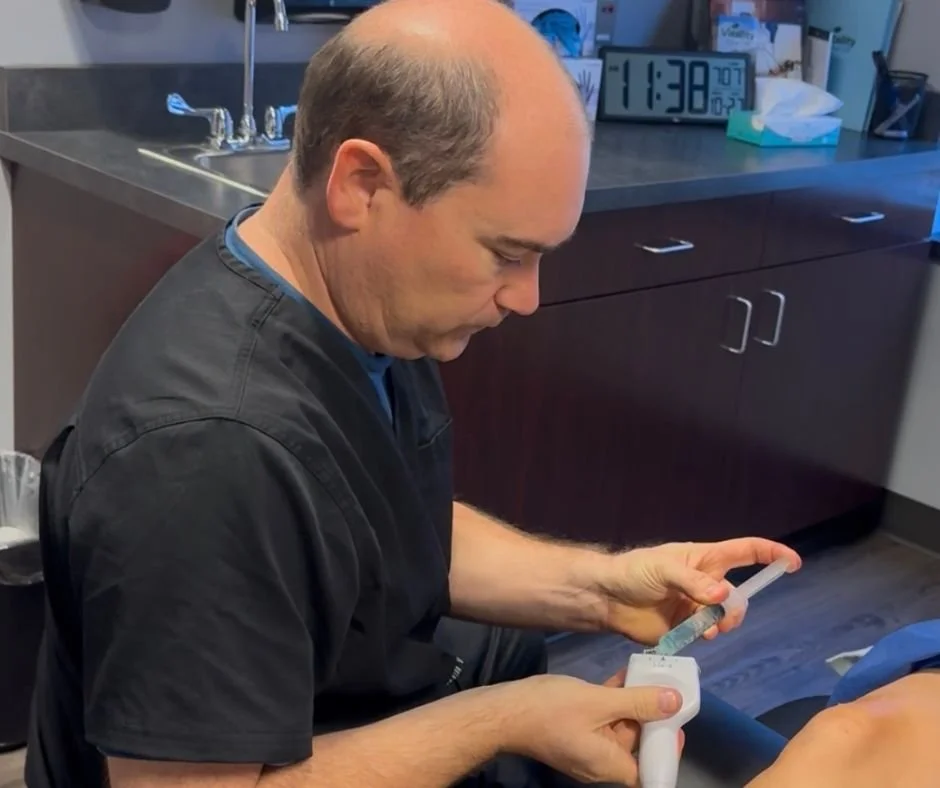
• Injection: Dr. Brooks injects the concentrated material into the target joint under real-time ultrasound guidance to ensure precise placement.
Loose, comfortable clothing that allows easy access to the treated joint is recommended.
Recovery and What to Expect Afterward
Mild to moderate soreness at both the harvest site and the treated joint is normal and typically resolves within three to five days. This is part of the biological process — the controlled inflammatory response at the treatment site is one of the mechanisms by which orthobiologic therapy is thought to work.
NSAIDs must be avoided for an instructed period of time after the procedure for the same reason: suppressing inflammation during this window may interfere with the biological process you've invested in. Acetaminophen and ice are appropriate for discomfort during recovery.
The biological response to BMAC unfolds over weeks to months. Most patients do not experience a significant change in symptoms immediately after the procedure. Clinical literature suggests that meaningful changes in pain and function, when they occur, are more commonly reported at the three- to six-month mark.
Important: Orthobiologic procedures are not guaranteed to produce a specific outcome. Results vary based on individual factors including age, health status, degree of joint degeneration, adherence to the recovery protocol, and biology that is not yet fully predictable by any measure.
Is BMAC Therapy Right for You?
If you are living with joint pain that is limiting your activity, and you are interested in exploring non-surgical options, BMAC may be worth discussing with a qualified physician. It is a meaningful investment — financially, physically, and in terms of recovery commitment — and it deserves to be evaluated carefully, not marketed broadly.
Good candidates tend to share a few things in common: realistic expectations, a willingness to commit to the pre- and post-procedure protocol, a degree of joint degeneration where orthobiologics have the best evidence, and an overall health picture that supports the therapy.
The first step is a consultation. At that visit, Dr. Brooks can review your imaging, examine the joint, and give you an honest assessment of whether BMAC — or another non-surgical option — is likely to be beneficial in your case.
Patients come to us from throughout the Quad Cities — including Davenport, Bettendorf, Moline, and Rock Island — as well as from Iowa City and Cedar Rapids.
About Dr. Joseph Brooks, DO
Dr. Joseph Brooks is a Physical Medicine & Rehabilitation (PM&R) physician, holding board-certifications in both PM&R and pain medicine. Dr. Brooks has additional training in musculoskeletal ultrasound and orthobiologics/regenerative medicine. At his practice in Davenport, Iowa he offers orthobiologic procedures — including BMAC, PRP, and Autologous Adipose Matrix — a cash-pay regenerative medicine clinic serving patients throughout the Quad Cities, Iowa City, and Cedar Rapids.
All orthobiologic therapies at Vitality Wellness Center are autologous, meaning they are derived entirely from the patient's own biology. No donor tissue is used.
Schedule a Consultation
If you're dealing with joint pain and want to understand your non-surgical options, we invite you to schedule an evaluation with Dr. Brooks. Consultations are billed to insurance where applicable.
Call 563-424-6400 or schedule online.
This article is intended for general educational purposes only and does not constitute medical advice. Orthobiologic therapies including BMAC are not FDA-approved treatments for osteoarthritis or other joint conditions, though the procedures themselves are performed using FDA-cleared equipment and autologous tissue. Individual results vary. This content is not a substitute for evaluation by a licensed physician. Always consult a qualified healthcare provider before making decisions about your care.
